

Editor note before you read the article from Sarah Taylor.
Dr. Mark J. Matney Editor and Chief:
The Town must surely know they cannot deny public records to the public. How anyone in Marion could deny records to the Mayor is insane.
Sarah Taylor:
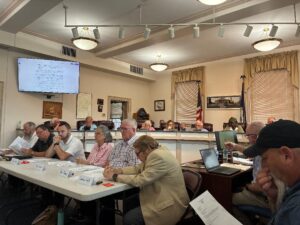
The Marion Town Council’s Monday meeting was marked by pointed exchanges, passionate citizen remarks, and an intensifying debate over government transparency and the powers of elected officials—especially the mayor.
The meeting began with swift movement through the formal agenda, including three public hearings called by the Planning Commission. One key action was the approval of a resolution authorizing the issuance and sale of a general obligation and water/sewer revenue bond not to exceed $780,293—a step toward local infrastructure improvements.
The Planning Commission also amended the town’s Tree Ordinance, removing boxwoods and crepe myrtles from the list of restricted plantings and clarified the ordinance applies only to public property and rights-of-way.
Proposed changes to the Livestock Ordinance triggered citizen concern, particularly over ambiguous language that did not include emotional support animals and the impact on local vendors. One such vendor, who sells goat milk products at the Marion Farmers Market became the topic of restrictions that would prohibit reproduction or replacement of animals—even though they would be grandfathered in. Several argued that this threatened this vendor’s business and advocated for changes.
In a moment of levity tinged with confusion, Zoning Official Todd Long read aloud that the draft ordinance does allow and exception of ownership of one pot-bellied pig, leading citizens to question why such an exception was made.
The ordinance also bans exotic animals without licensure, which some residents saw as government overreach. Throughout this discussion, poor audio quality made it difficult for the audience to follow. Microphones were either not used or not working properly, prompting repeated public complaints.
During public comment, Attorney Mike Thomas strongly defended Mayor Avery Cornett’s recent request for water billing records, stating the request was improperly diverted to “personnel matters.” Citing Town Code 2-81, Thomas argued the mayor has an obligation to oversee departments and must have access to records to do so.
“The fact that there was such an effort to oppose this request and divert this to personnel gives great concern to what should have been a simple administrative request,” Thomas said.
Several residents voiced frustration with the town’s handling of ordinances and services.
Bennett Hutton read a citizen-drafted resolution commending the mayor’s transparency efforts and criticized the town’s use of certified mail for trash violations as wasteful and aggressive.
Glen Robinson expressed concern about a quadplex in his neighborhood, which had originally been presented as townhomes but was later revealed to be recovery housing. He expressed concerns about Mount Rogers and Open Door of misleading the community.
“If this was happening somewhere else in town… you would be more likely to have a different outlook,” he told the council, citing specifically Wassona Park or Park Blvd. areas.
Kelly Skeens offered an informative defense of elderly and disabled residents, calling the new trash ordinance’s timing requirements unreasonable and condemning estimated water billing practices. Quoting Section 78-42 of the town code, she requested that meters be read monthly and refunds issued.
“I believe the town owes a substantial credit on everyone’s bill… The council needs to remember—you work for us.”
Danny Parks, under a second nuisance abatement order, claimed he had sought clarification on cleanup requirements but was ignored.
Charles Hayden challenged the town’s bow hunting ban, claiming Attorney Fenyk had misapplied State Code 29.1-526, which he says makes no mention of bow hunting. Hayden called for Fenyk’s resignation, citing repeated legal overreach.
Dr. Wassum contrasted the livestock ordinance that affects a goat milk product vendor with the unchecked rise of seven vape shops in town. He also questioned the legality of the town granting itself authority to enter private property, calling it an overreach.
The meeting’s most heated moments centered on the ongoing dispute over the mayor’s authority to access records.
Vice Mayor Gates criticized Mayor Cornett’s request for water billing data, calling it excessive and burdensome to staff.
“Auditors reviewed our systems and found no discrepancies. We do not accomplish a resolution to issues by admonishment,” Gates said, concluding with a sarcastic, “I’m not going to get a clap,” which triggered one or two claps and pushback, with some accusing him of publicly bullying the mayor.
In his report, Mayor Cornett defended his legal authority and responsibilities, citing Virginia Code, the town charter, and municipal code. He emphasized that the mayor is not a ceremonial role but has executive obligations—especially in the absence of a town manager.
“I do understand my duties, and I intend to carry them out transparently,” Cornett declared to applause.
Attorney Fenyk attempted a rebuttal but stumbled over documents and failed to cite clear legal authority to support his position that Marion operates under a “strong town manager” model—an assertion met with skepticism.
Tricia Spencer claimed the mayor’s water billing request could involve up to 180,000 pages of records. Cornett disputed that, saying the data is digital and easily shareable citing that it was digitally prepared and provided to an auditor annually.
Todd Long defended the ordinances, acknowledged imperfections, and stated department heads—not zoning—hold final accountability.
Councilman Larry Carter discussed federal and state budget cuts and tried to explain the mayor’s voting role historically, though he struggled to cite legal sources.
Councilwoman Susie Jennings, reading from a statement, defended staff and criticized what she viewed as public shaming over water department issues.
The Marion Police and EMS gave their public safety reports. Ken Heath reported on economic development, including the reopening of Sisters Café.
The meeting concluded with renewed applause following Mayor Cornett’s closing remarks, marking a pivotal moment in Marion’s ongoing internal struggle over transparency, accountability, and the distribution of power in local government.
A follow-up article will explore in greater detail the citizen resolution supporting Mayor Cornett and the broader implications for mayoral authority under Virginia law.
There will be additional articles to follow with the details of specific happenings of this council meeting to include the Mayor’s commendation and details.

