
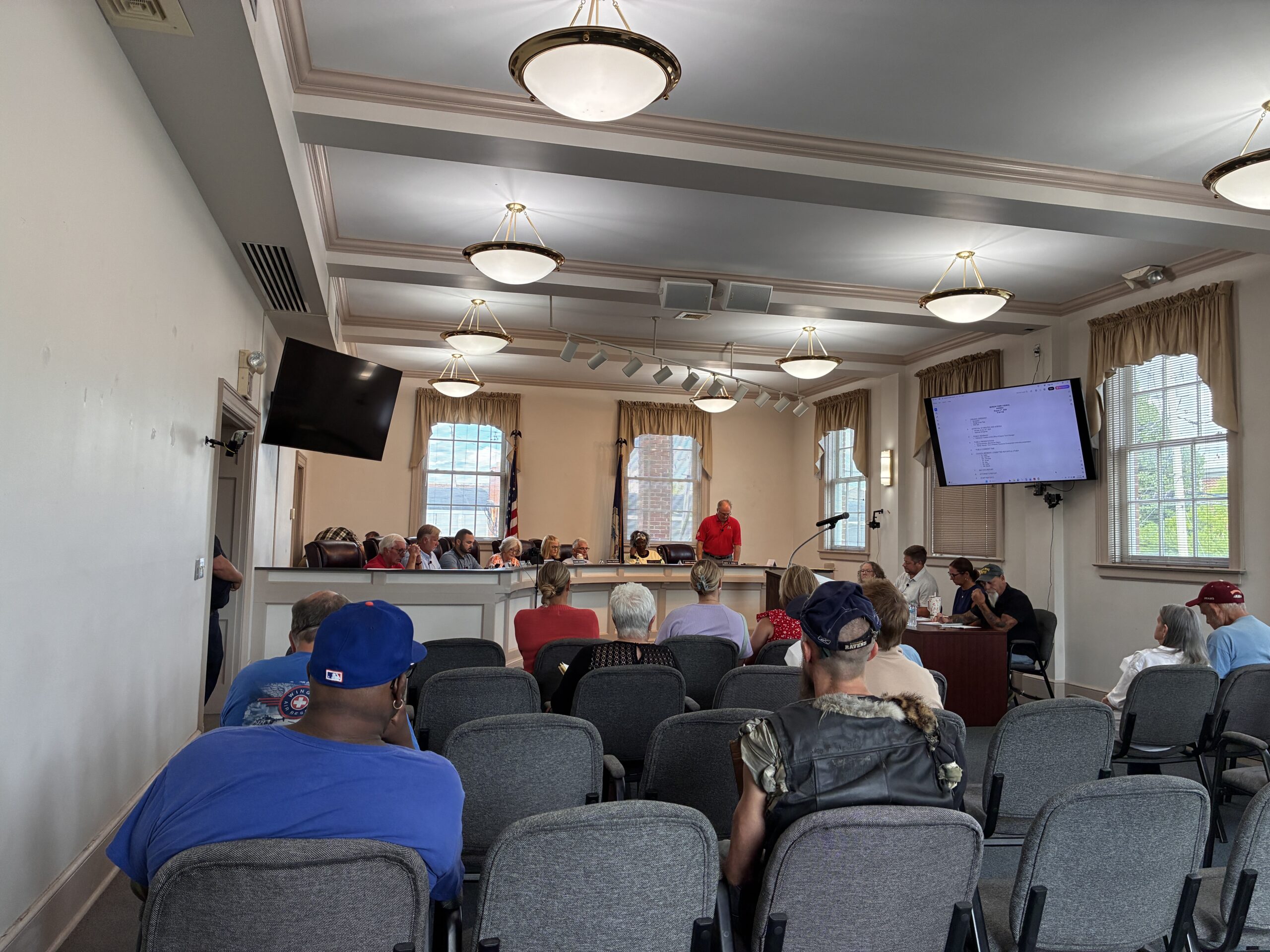
Marion Town Council moved through a dense agenda Monday night, ultimately voting unanimously to change the town code’s nomenclature from assistant town manager to deputy town manager—a shift that sparked substantial questions, confusion, and public comment before the vote was taken.
Public Hearing: Clarifying the Chain of Command
Town Attorney Mark Fenyk opened the public hearing by explaining that Virginia code references a deputy town manager, while Marion’s ordinance has long used the term assistant town manager. Under state law, the town manager may appoint an assistant without council involvement, while the deputy—who assumes authority in the manager’s absence—is appointed by council.
Fenyk described the change as largely a matter of nomenclature, noting that Marion has historically had an assistant town manager, including Cecil Hicks more than 30 years ago. The mayor, however, pressed repeatedly for clearer definitions of “absence,” arguing that the chain of command should not be left ambiguous and could range from being out of the building to being incapacitated.
Council members and staff offered differing interpretations. Town Manager Andrew Keen clarified that one position would be appointed by staff and the other by council. Larry Carter insisted the state had “done the leg work” and Marion simply needed to align its ordinance. Susie Jennings questioned why her committee was bypassed and reiterated that Keen “should be making his own decisions” about assistants.
Public comments reflected similar confusion. Dr. Wassum questioned why a public hearing was needed, saying he believed the town manager should appoint his own people. Jim Talley asked for clarity on authority differences, while Roger Bowman questioned the need for the change at all, asking why the town suddenly needed to rush the matter through when it had operated for decades without a deputy.
Despite the debate, council voted unanimously to adopt the ordinance change. Councilmember Hunter Atwell then moved to appoint Tony Muncy as deputy town manager. Samantha White will serve in the other position.
Public Presentations
Brandy Branson, founder of Beyond the Stigma Recovery Housing, spoke about her work establishing long‑term recovery housing in Southwest Virginia. She described seeing both successful recoveries and relapses tied to unstable environments and emphasized that recovery is a lifelong commitment. She thanked council for hearing her proposal.
Virginia Tech senior Parker Henson, introduced by Economic Development Director Ken Heath, presented findings from his summer internship project: a downtown business assessment tied to the Marion 2035 plan. Henson explained that business owners consistently praised Main Street visibility but expressed concerns about limited parking, inconsistent marketing, and the need for stronger collaboration among downtown businesses. He noted that most respondents supported additional beautification efforts. Mayor Cornett presented Henson with a lapel pin in appreciation for his work.
Public Comment
 Bill Stamper praised Town Manager Keen’s responsiveness and asked council to consider his application for the Planning Commission, saying public service “is not about us, it’s about the people.”
Greg Rashad requested restrooms at Steele Park and signage clarifying that the picnic area is not a dog park.
Robbie Colley recommended installing Flock ALPR cameras downtown, citing increased activity around Iron Street Mall and the farmers market. He expressed that he had been a customer at Councilwoman Tricia Spencer’s Iron Street Mall business Sip & Savor located in the vicinity.
Charles Hayden asked whether any similar‑sized Virginia towns use a deputy town manager model and requested examples for comparison.
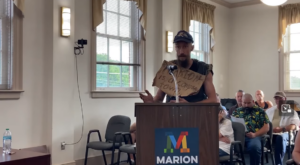
Gregory Graham stated he was fired from Mount Rogers Employment Services for union organizing and wore a cardboard sign reading “Marion is a Company Town,” saying he wanted the town to be aware of the situation and hoped to represent employees there.
Reports
Council had no reports. The mayor and town attorney also had none. Staff reports included reappointments to the Planning Commission and BZA announced by Todd Long. Chief Keesling reported rising call volumes, noting 232 calls in June and 280 in July. Town Manager Keen congratulated a Water Department employee for earning a credential and updated council on Food City’s relocation, explaining that the current lease ends in August and the new store is expected to open in September.
Closed Session and Appointments
Council entered closed session to discuss the transfer of more than 250 acres to the Marion Economic Development Authority. Upon returning to open session, Councilmember Larry Carter moved to appoint Sarah Reedy to the Tree Commission vacancy left by Tom Hower. By motion of Dr. Gates, Robbie Colley was appointed to an unexpired term on the Board of Zoning Appeals. Council also appointed Charles Harrington to the Planning Commission, filling the expired term previously held by Mark Firestone.
The agenda reflected “Council appointed selection procedure” rather than indicating these appointments would occur following closed session. Three County News was told that at least eight individuals expressed interest in the various appointments and also is aware that the town manager directed that qualifications be requested from those interested. Several who spoke to 3CN about their interest in these positions indicated that they had promptly submitted their qualifications upon request.
Virginia FOIA requires public bodies to clearly state the specific purpose and legal exemption for any closed session, and appointments to boards or commissions cannot be discussed privately because they are public offices, not personnel matters. In this case, the agenda listed only “Council appointed selection procedure,” yet council entered closed session for a land‑transfer discussion and then returned to make several appointments. If any part of those selections was discussed behind closed doors, it would fall outside FOIA’s permitted topics. The way the meeting was conducted raises clear compliance concerns, though whether it was legally improper would depend on what was actually discussed and whether the process is formally challenged.
Live stream of this meeting can be viewed here.

