
Are skill games legal in Virginia? A Hanover ruling, a Marion permit, and a statewide question mark.
Virginia’s long running fight over so called “skill games” has entered a new and confusing chapter—one where a single court ruling in Hanover County has collided with a statewide ban, leaving localities like Marion to navigate a legal landscape that even prosecutors describe as murky. And as Marion Town Council continues issuing Special Use Permits for up to two machines per business, the question becomes unavoidable: Is Marion actually operating within Virginia law?
Virginia’s General Assembly banned skill games in July 2020, and the Virginia Supreme Court upheld that ban in 2023. Under the statute, any device requiring something of value to play and offering something of value in return is considered an illegal gambling device. That law has not been repealed, amended, or replaced.
In April 2025, a Hanover County General District Court judge dismissed charges against a convenience store owner operating Queen of Virginia Skill 2 machines. The judge found that the machines did not meet the statutory definition of illegal gambling devices and criticized the law as too ambiguous to enforce fairly. The judge determined the machines did not require players to insert money to play, which undermined the state’s definition of gambling. The court dismissed the case entirely, calling the statute unclear and unenforceable in that instance. Legal analysts noted the judge refused to convict someone when they didn’t know it was a crime.
Despite the headlines, the Hanover decision came from a General District Court, the lowest tier of Virginia’s judiciary. It applies only to that specific case and does not bind any other court or jurisdiction. It does not overturn the statewide ban, which remains in effect unless the General Assembly changes the law or a higher court issues a controlling decision. Even prosecutors in other localities have acknowledged the ruling only deepens the uncertainty, with Alexandria’s Commonwealth’s Attorney describing the situation as murky.
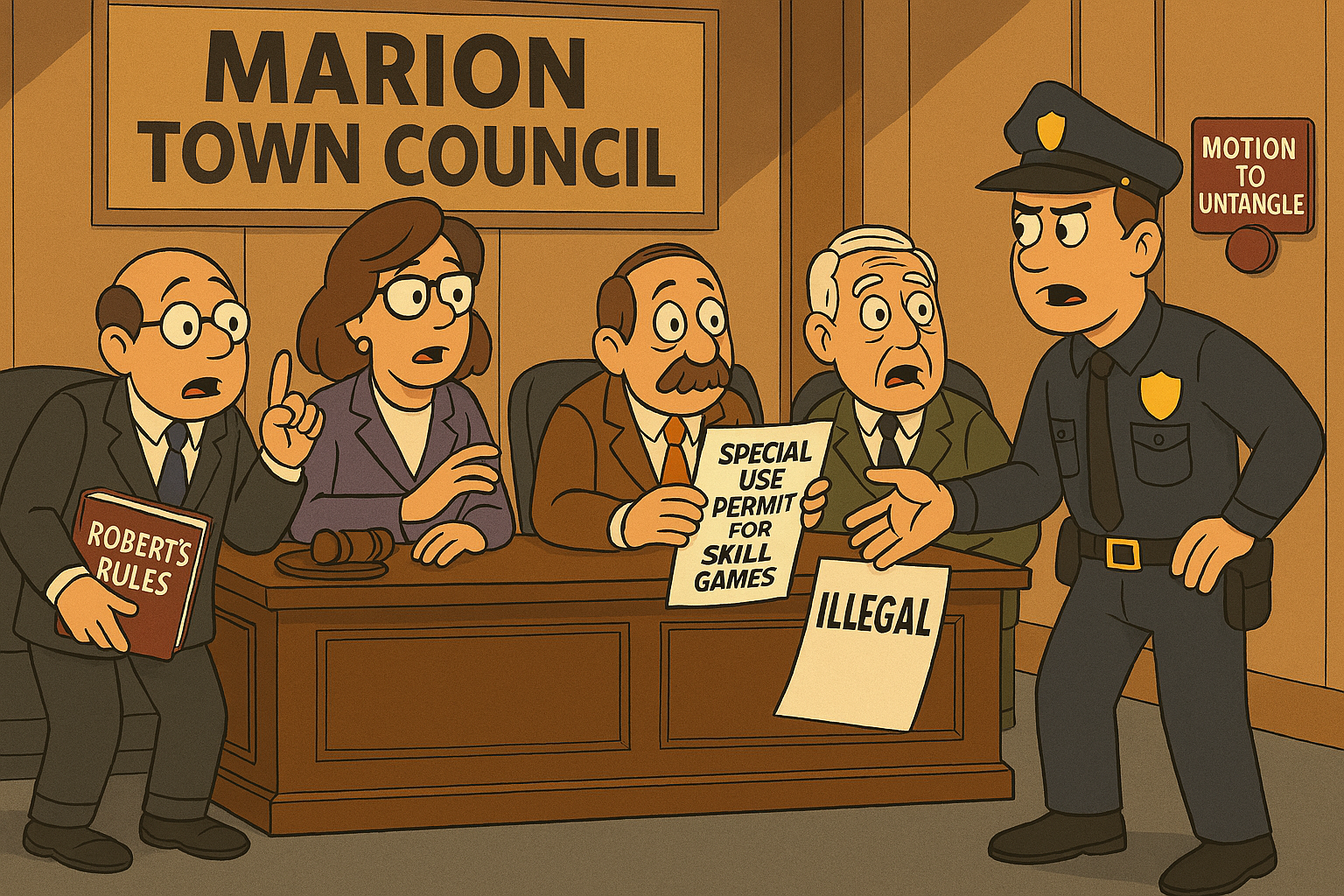
At its recent public hearing, Marion Town Council considered a Special Use Permit request from the Sunoco station on Main Street. Staff reported that the business license already allows two machines and that the devices presented were deemed legal under the town’s interpretation. Council members and the public debated the broader impact of skill games on Main Street’s character, with concerns raised about gambling, aesthetics, and the proliferation of vape shops and tattoo signage. Town Attorney Mark Fenyk emphasized that the Council’s role was simply to issue a permit for machines the town considers legal under its ordinance. The permit passed unanimously, allowing the business to operate two machines.
This is where the tension becomes unavoidable. Marion’s ordinance allows up to two skill games per business with a Special Use Permit. Town officials appear to be operating under the assumption that certain machines—particularly those similar to the QVS2 devices—are legal to permit. But the Commonwealth’s position, as written in statute and upheld by the Virginia Supreme Court, is that skill games are banned statewide.
Because the Hanover ruling is not binding outside that county, Marion’s decision to issue permits rests on a legal interpretation that is not supported by statewide precedent and may conflict with the existing ban. In other words: the state says the machines are illegal; a single local judge said certain machines are legal, but only in one case; and Marion is issuing permits anyway. This puts Marion businesses—and potentially the town itself—in a legally vulnerable position if state enforcement resumes or if a Commonwealth’s Attorney decides to challenge the machines’ legality.
The General Assembly is widely expected to revisit the issue, as legislators, prosecutors, and local governments all acknowledge the law is unclear and inconsistently enforced. Until then, Marion’s permit process continues operating in a gray zone—one where local zoning authority intersects with a statewide criminal prohibition that has not been lifted. For now, the only certainty is uncertainty.
If the town council is issuing these permits in violation of the law then according to AI this can lead to serious consequences:
Penalties for Illegal Operation
Should the machines be deemed illegal in a higher court or during a local investigation, penalties include:
Civil: Up to $25,000 per device and seizure of equipment.
Criminal: Operators can be charged with a Class 6 felony (up to 5 years in prison), and players can be charged with a Class 3 misdemeanor.
For official verification of Marion’s specific permit criteria, you should contact the Town of Marion Government.

