
Todd Long, Zoning Administrator,
Began proceedings on the loitering ordinance public hearing. On September 15, 2025, he was directed to draft a loitering ordinance. He proceeded to read state law referring to a Class 3 misdemeanor and defined loitering per law. Todd mentioned that he had researched and sourced loitering ordinances from other localities near Marion, mentioning Bristol specifically that he deemed reasonable and effective for Marion. He prefaced his reading with the statement, “This ordinance in no way infringes on anyone’s right to peaceful protest.”
Ordinance Text:
Sec. 46-1.1 Loitering or prowling
(a) It shall be unlawful for any person or persons to stand, gather, or loiter on any sidewalk, street, public ground, or public way in the Town of Marion in a manner that obstructs, hinders, or impedes free passage or access to or from any place of business, institution, public building, or property. No person or persons gathered shall refuse or neglect to move, depart, or allow free passage after being asked to do so by the owner, lessee, tenant, manager, or occupant of the premises obstructed as described or upon the order of any Town police officer.
(b) It shall be unlawful for any person to hide, wait, or loiter near a private dwelling, apartment building, or other residence with the unlawful intent to secretly observe the occupants.
(c) It shall be unlawful for any person to loiter in or about any public restroom for the purpose of engaging in or soliciting any lewd, lascivious, or unlawful act.
(d) It shall be illegal for anyone to lodge in any building, structure, or place, whether public or private, without the permission of the owner or the person in possession or control thereof.
(e) It shall be illegal for any person to loiter in or around any restaurant, tavern, or other public building. As used in this subsection, “loiter” means to, without just cause, remain in a restaurant, tavern, or public building, or to stay on the property immediately adjacent thereto, after being asked to leave by the owner, person entitled to possession or in control thereof, or by any police officer.
(f) It shall be unlawful for any person to sleep in any public park, on public benches, in a public square, or on a public sidewalk, or to park or remain parked in a motor vehicle at any public place or any place open to the public, and to engage in any conduct prohibited under this section.
(g) Any individual found guilty of violating any part of this section shall be guilty of a Class 3 Misdemeanor.
Public Comment:
1. J.S. Staley:
Shared a personal experience at the Marion post office where he saw a vagrant sleeping in the vestibule at the main entrance. He called 911 but was uncomfortable checking the individual’s well-being due to concerns over mental illness and his own safety.
He Expressed frustration with mental health professionals for not addressing such situations and noted that these incidents are becoming more common. He urged corrective action before the problem worsens in the spring.
2. Tom Hower:
Commended Marion Police Department for its quick response when an individual was seen walking near his property. However, he expressed strong opposition to the ordinance, calling it a violation of civil liberties with potential for abuse.
Raised concerns that the ordinance is exclusionary and could unfairly target people who don’t fit a certain image of the town. He specifically pointed to the phrase “without cause” in the ordinance, questioning its potential to infringe on the constitutional right to assemble.
He also warned that the ordinance could lead to selective prosecution, particularly in cases like people staying in RVs at places like Walmart’s parking lot or resting in parks. He feared that business owners could misuse the ordinance to eject people, leading to discriminatory enforcement.
3. Kayla Keilholtz (Pastor of Ebenezer Lutheran Church):
Read scripture from The Holy Bible- Matthew 25
Focused on section F of the ordinance, which prohibits sleeping in public spaces. She argued that the ordinance disproportionately targets the unhoused population in Marion, which is a significant concern for the small town.
She shared her experience of helping unhoused individuals, including carrying a woman who she described as “bleeding out from a miscarriage” to a vehicle to go to the hospital and emphasized the need for compassionate, not punitive solutions. She called for greater support for the poor as mandated in the Bible, stating, “Homelessness isn’t going to just go away.”
4. Charles Hayden:
Criticized the ordinance by pointing out a historical context in which Marion had invited people to use public spaces, like benches such as the ones along Main Street, but was now attempting to exclude certain groups.
He showed photos from the pandemic of blocked sidewalks where seating and outdoor dining areas were blocking sidewalks and compared them to situations where people were simply standing around or occupying benches, questioning if such activities would be criminalized under the ordinance.
“I’d be ashamed of passing this ordinance if I were the one putting those benches out there…you invited the people to sit on Main Street but you are now trying to get rid of a class of people.”
He called out the discriminatory nature of the ordinance, which may target those who don’t align with the town’s image.
5. Bill Stamper:
Recalled an Andy Griffith episode about a hobo being arrested, drawing parallels with the ordinance and questioning when the vagrancy law would come into play.
6. Bill Huber:
Suggested that public parks and greenspaces should allow people to rest and take naps, which he viewed as a natural and appropriate use or enjoyment of these spaces.
He expressed concerns about business owners being able to tell people to leave, which he described as vigilante-like. He believed that disputes should be handled by law enforcement, not individual business owners.
7. Crissy Prater:
Stated that she had never felt unsafe in Marion and, as a woman, has napped in public without concern. She expressed doubts about the effectiveness of loitering ordinances, especially for those struggling with mental health or housing issues.
Prater felt that the issue wasn’t as widespread as some had claimed and questioned whether it justified a loitering ordinance at all.
8. Barbara McClellan:
Recalled her experiences during the 1980s when the state hospital was releasing people who were no longer considered patients, and shared her positive experiences working with the unhoused at the public library. She suggested that the town should deal with the issue of homelessness more creatively rather than relying on ordinances.
McClellan called on the council to support the organizations already helping the unhoused, acknowledging that it would require community effort and creativity.
Council discussion of this public hearing included:
Vice Mayor Gates suggested that the ordinance should be adjusted to better meet the needs of the town’s citizens.
Jennings seconded the motion, saying that this hearing had opened her eyes to issues she wasn’t fully aware of.
The Mayor, Avery Cornett, clarified that the public hearing was for input only and not to determine the ordinance’s fate. He asked the council to either accept or reject the ordinance.
Larry Carter questioned the legal validity of the ordinance as written, especially in light of the potential for abuse and lawsuits. He asked town attorney Mark Fenyk whether the ordinance would stand up in court.
Mark Fenyk explained that ordinances challenged in other towns typically dealt with illegal activity (e.g., prostitution, drug use), and the ordinance could pass legal scrutiny if it was tied to such illegal actions. However, he acknowledged that non-criminal conduct could still be problematic under the current language.
Mr. Mercer (owner of the new pawn shop on Main Street) expressed concerns about the power of business owners under the ordinance, noting that the ordinance could take police involvement out of the equation and lead to lawsuits or unfair application.
Kevin Testerman, Marion Police Chief, clarified that police officers would be involved in any enforcement, and they would assess situations to determine appropriate action.
The Mayor recommended that the ordinance be sent back to the committee for further revisions and that another public hearing would be scheduled after those revisions. The council acknowledged the need for public input before moving forward, and the hearing was closed, with the matter sent back to committee for further consideration. The Mayor emphasized that the public needs to be made aware of the ongoing activities concerning this ordinance.
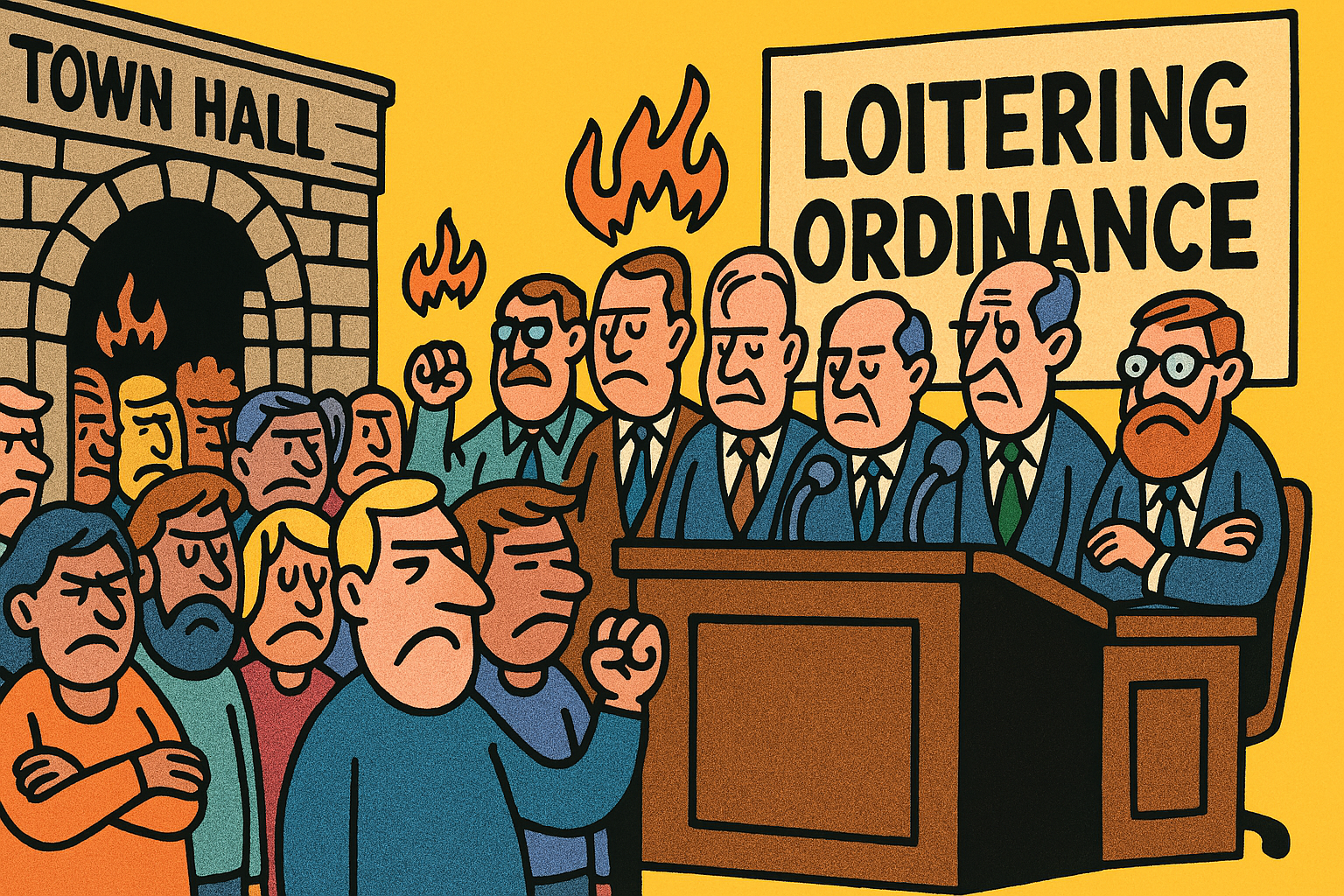
This meeting clearly revealed divided opinions on the proposed ordinance, particularly around the concerns of civil liberties, homelessness, and the potential legal challenges. The council appears committed to further exploring the issue, with the understanding that compassionate, creative solutions will need to be considered alongside the need to maintain public order.

