

On August 6, 2025, the Town of Marion carried out a property abatement at the Henry Street residence of Danny and Becky Parks—an event that has since raised serious questions about due process, legal compliance, and the rights of property owners in Marion.
This was not the first abatement at the Parks’ property. In February 2024, the town performed a similar action, but that event came with a legal process that had begun earlier in January 2024 and concluded in the courts October 2024.

Court filings and records from that case establish that property owners are permitted to bring their property into compliance by placing items out of public view—such as behind a privacy fence or wall.
Section 38-2 of the Town of Marion Code outlines the procedure for property complaints. Among other requirements, it specifies that complaints must be filed in writing, signed by the complainant, and submitted to the Marion Police Department. No documentation of this was produced.
Further complicating the matter, the town’s own enforcement officer, Flave Davis, had filed a letter which was part of the case file from 2024 stating items behind a privacy fence would not constitute a violation. Yet during the recent August 2025 abatement, town employees dismantled and removed the Parks’ privacy fence—hauling it away along with property contained within the fenced area. According to the ordinance, fencing may only be removed if “defaced” or damaged in certain ways. In this case, no such condition was documented. Among items removed was an appliance that was in use and contained food. When asked to provide an itemization of things taken from the property, the written response from town attorney Mark Fenyk was “The Town of Marion will not be providing you with a list or itemized value of all trash, junk, cast off materials and other grass weeds and debris which was abated. “Seeming to equate everything taken to common trash and debris.

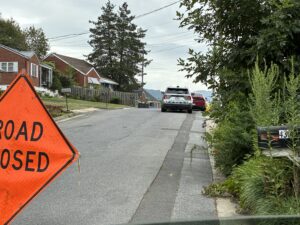
Adding to the controversy, town officials took unusual steps to restrict witnesses and reporters from observing the August 6 operation blocking the street off further out from the residence instead of immediately in front of the residence like last time. The street was blocked at the corner of Henry and Sprinkle on one end and at the bottom of Allen Avenue near Ogborn Park below the residence. No court filings for the abatement could be located in Smyth County courthouse records, raising additional concerns about whether proper legal channels were bypassed altogether.
The fallout did not end there. Property owner Danny Parks was arrested during the abatement and charged with assault on town enforcement officer, Flave Davis—a case that was continued in Smyth County General District Court last week.
The Parks family is actively seeking legal counsel to challenge the town’s actions and allegations. A supplemental request was made for the specific video from Flave Davis’ body worn camera showing the assault. Town attorney Mark Fenyk responded “All videos in the Town’s possession relating to the abatement of your property on August 6, 2025, were provided to you. Included in these videos were all the videos from Flave Davis’s Go Pro device.”
Meanwhile, efforts to obtain public records connected to the abatement have been met with resistance. Emails from Becky Parks requesting information under the Freedom of Information Act (FOIA) were met with Town Attorney and FOIA Officer Mark Fenyk issuing a response and later upon further request, the fee breakdown he provided was shocking:
• Six hours at $64.11/hour for gathering videos and pictures
• Eighteen minutes at $200/hour for FOIA Officer review
• $64 for a hard drive
Fenyk also included the warning: “Please remember that the charges are estimates and will continue to increase with each of your emails and requests.”
So, they are charging just to receive an email?
The total came to a staggering $508.66—an amount that was quickly raised within 48 hours by concerned citizens payment was delivered publicly on record at the council meeting on August 15. Yet, when Danny Parks went to retrieve the requested records, he was turned away. Town officials insisted they would only release the materials to Becky Parks since she had sent the email request. Only after a third party was designated later that day were the materials finally released. Both Mr. and Mrs. Parks would fall into the elderly/disabled category which made it more difficult for Mrs. Parks to leave the house.
The legality of these fees also raises questions. Virginia’s FOIA law prohibits charges for overhead and duplication of services already funded by taxpayers. As the town’s attorney and designated FOIA officer, Fenyk is already compensated to perform these duties—raising questions as to why additional charges at $200 per hour were imposed for his services as FOIA officer to respond to requests. Additionally, his representation of town employee Flave Davis on the assault charge may pose a direct conflict of interest considering his involvement as the town’s FOIA officer on this same matter.
In a separate conversation about a different FOIA request, Zoning Administrator Todd Long remarked that “if they had just brought a flash drive down here, we would have copied it for them free.” This statement has struck many as disingenuous, given that formal requests were made and copied to Mr. Long. It also brings into focus the absence of any written published FOIA guidelines or policies on the town’s website while other local governments and public entities such as the Smyth County Sheriff’s Office, Smyth County Offices and the Smyth County House have clear and available policies listed on their respective websites.
The August 6 abatement is quickly becoming a flashpoint in the broader discussion of citizens’ rights, government accountability, and transparency in Marion. As the Parks family seeks legal representation and their community rallies around them, the legality of the town’s actions—and the costs imposed on citizens who ask questions—may soon face much closer scrutiny.
The right and wrong thing could be a question here? Should we not try to help those in need in instead of acting like a communist take over of someone’s property. In this instance it certainly was not the Christian thing to do.
This is a developing story.

