

MARION — A crowd filled the Marion Senior High School auditorium Thursday night as the Board of Supervisors and Planning Commission held a joint public hearing on proposed amendments to the county’s zoning ordinance pertaining to data centers. The meeting, intended as a listening session, drew more than 2 hours of impassioned commentary, repeated calls for a moratorium or outright ban, and pointed questions about environmental protections, water use, noise, and long‑term impacts on rural communities.
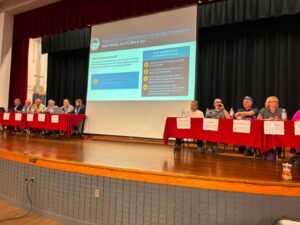
The hearing was marked by frequent requests from attendees for board members and speakers to use microphones and for volume to be adequate, underscoring the size of the crowd. A slideshow outlining the proposed ordinance was put up on a large projector screen on stage and is available at smythcounty.org.
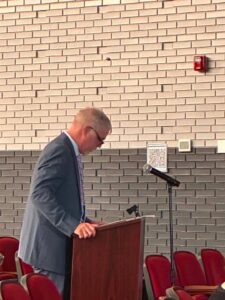
Planning and Zoning Director Clegg Williams opened the hearing by emphasizing that no data center proposal is currently under consideration in Smyth County. He noted that under existing zoning rules, data centers are already permitted by right in two zoning districts—meaning an applicant could obtain approval without a public hearing if technical requirements are met.
The proposed amendments would change that.
Williams explained that the ordinance would require all future data center applications to obtain a Special Use Permit (SUP), triggering a public review process identical to the one used for the ordinance itself. Applicants would have to submit detailed technical information, and approval would not be guaranteed.
“Tonight is about having a clear process for reviewing future proposals on a case‑by‑case basis,” Williams said, adding that the goal is to “give citizens a voice in our future.”
Several written comments were read into the record before in‑person testimony began.
Andrew Cassell criticized what he called an ambiguous public notice and argued that a proposed 55‑decibel noise limit was too high. He also said the county had not addressed water and electricity costs.
Fairfax Arnold urged the Board to enact a moratorium, citing noise, low‑frequency vibrations, and potential health impacts. Her comments drew the first major applause of the evening.
Roberta Arnold also requested a moratorium—specifically a four‑year pause—to allow the county to fully study environmental and community impacts.
Sandy Seymour and Kenna Snyder went further, calling for a total ban on data centers in Smyth County.
Rose Likins thanked the Board for its work but proposed three amendments:
-
-
A 120% decommissioning bond,
-
Certification from energy providers that service would not burden the county, and
-
Stronger requirements on waste disposal and water consumption.
-
Many residents spoke during the public comment period, which limited speakers to three minutes each.
“Data centers are not appropriate for Smyth County”
Dr. Wassum, who requested additional time for a prepared speech, delivered one of the evening’s well researched and referenced presentations. Citing past local zoning debates and the county’s agricultural heritage, he argued that large‑scale data centers require massive buildings, high‑voltage power lines, and significant water use.
“Data centers are not appropriate for Smyth County,” he said to repeated applause. He referenced a 2001 meeting he attended, citing commentary from county representatives at the time, including Sally Morgan, who worked for the county and stated, “zoning will protect against obnoxious land uses and preserve farmland.” This proposed ordinance opens the door to data centers in farmland and threatens country living.
At that same 2001 meeting, J. S. Staley said, “Zoning lays out the rules for land use in advance.” Wassum pointed out that the proposed ordinance changes those rules. Others were quoted saying, “Zoning is protection of your property” and “People in the county want to be left alone.”
He concluded that the proposed zoning ordinance lessens the protection of property in Agricultural and Agricultural/Rural zones and warned that it could ultimately “make a data center your rural neighbor.” He went on to describe data centers in detail, calling them “massive buildings on massive sites with massive computing workloads analyzing massive amounts of your data using massive amounts of energy and water causing water, air, soil pollution continuous noise.” He cited the Piedmont Environmental Council’s website as a resource for further information.
He also suggested that the county hold additional informational meetings to explain “who wants data centers and why, who benefits and who doesn’t.” He concluded this portion of his remarks by stating, “Data centers are not appropriate for Smyth County.”
Wassum then turned to a 2023 study by Amanda Livingston, director of tourism for the Smyth County Tourism Association, recommending that supervisors and planning commissioners read it. The study notes that people moving to Smyth County typically visit first, and that visitors cite scenic natural beauty, parks with water, mountain views, museums, and friendly people as primary attractions. “Data centers are not an attraction for people who are moving away from other data centers.”
Wassum again received applause when he added, “Real intelligence comes from the God of the Bible who reveals himself in the beauty, peace and friendliness of people in Smyth County and in the righteousness of Jesus Christ.” He encouraged the Board to apply James 1:5 before any vote— “if you lack wisdom, let him ask of God.”
Other residents cited examples from Utah, Georgia, Wisconsin, and Northern Virginia where data centers have strained water systems or discharged treated wastewater into local streams.
Several speakers noted that Smyth County is already experiencing drought conditions.
Crystal Jennings warned that data centers could consume millions of gallons per day, threatening ecosystems and agriculture.
Becky Johnson questioned how the county could support facilities requiring 500,000 gallons of water per day, noting that “70–80% is lost to evaporation.”
Julie Loggins raised concerns about chemicals used in cooling systems and their potential impact on wildlife, pollinators, and human health.
Multiple residents described the “never‑ending hum” associated with data centers, referencing reports from Loudoun County where noise has driven residents from their homes.
Others cited diesel backup generators, low‑frequency vibrations, and potential impacts on mental health.
A resident from Chatham Hill Road said, “We like being able to get outside, have a garden… not worry about noise, pollution, wildlife leaving. We don’t need this in Smyth County.”
Several speakers challenged the idea that data centers would bring any meaningful economic benefits.
Matt Prater noted that Northern Virginia saw increases in machinery and tools taxes without long‑term job growth.
Another resident questioned whether 40 potential jobs could justify the risks, comparing the number to Walmart’s 200–300 employees.
A Sugar Grove resident said Southwest Virginia has a long history of industries extracting resources without benefiting local residents.
A number of younger residents and recent transplants also spoke.
Madeline Jennings, a High School student, urged officials to “protect Smyth County from big tech and data centers.”
Brittany, who moved to Sugar Grove six months ago, described the region’s natural beauty and rural lifestyle as life‑changing and worth preserving.
Gregory Taylor, a candidate seeking a seat on Marion Town Council, also addressed the Board. “I’m not going to throw facts at you; you have heard it all night. The fact is those that are elected are here to represent the people. From what I hear, everybody here has said no to a data center, I have not heard anyone in here say Yes. Your job is to protect the citizens and represent the people. Everyone’s saying no. Ban the data centers.”
Throughout the evening, speaker after speaker urged the Board to enact a moratorium, a request that was later undercut by county attorney Scot Farthing, who asserted that moratoriums are generally not permitted under Virginia’s Dillon Rule. Farthing offered no case law, citations, or supporting references for his claim, and he did not take direct questions from the public about the legal basis of his statement, leaving many in the audience visibly dissatisfied.
Some residents insisted the ordinance should explicitly ban data centers in agricultural and residential zones. Others argued that the county should “scrap this entirely” until more research is done.
When one speaker turned around to face the audience and asked the audience to raise their hands if they opposed data centers, the entire room responded by raising their hands.
Officials Respond: “Tonight is a listening session”
Smyth County Administrator Shawn Utt reminded attendees that no vote would be taken.
“There are seven members of the Board and seven members of the Planning Commission,” Utt said. “Tonight is a listening session only… Nothing is decided tonight.”
He encouraged residents to contact board members over the next four to six weeks as discussions continue.
Williams reiterated that the Planning Commission will take up the ordinance again at its next meeting, scheduled for the fourth Thursday of next month, before forwarding a recommendation to the Board of Supervisors.
When asked how the county would protect residents in the meantime, Williams noted that under current zoning, data centers are allowed by right in certain districts—one reason the county is considering amendments now.
The county attorney added that courts routinely strike down moratoriums, saying zoning regulations—not temporary bans—are the only legally defensible tool available.
As the hearing stretched late into the evening, residents continued to raise concerns about water sources, property values, environmental protections, and the county’s ability to enforce any future regulations.
Chairman dismissed the group saying “each one of you has a question we could ask questions all night as far as I am concerned this meeting is adjourned.”
Moving forward:
Planning Commission discussion and recommendation: Fourth Thursday next month
Board of Supervisors consideration: Following receipt of the Planning Commission’s recommendation
Public engagement: Officials encouraged residents to continue contacting board members with questions and concerns
All citizens are encouraged to reach out to their supervisor. Contact information is as follows:
Saltville District: Roscoe D. Call- Saltville@smythcounty.org
North Fork District: Rick Billings – northfork@smythcounty.org
Chilhowie District: Mike Sturgill- chilhowie@smythcounty.org
Park District: Kristopher S. Ratliff, PhD park@smythcounty.org
Atkins District: Charles E. Atkins atkins@smythcounty.org
Royal Oak District: Courtney Widener royaloak@smythcounty.org
Rye Valley District: Jason Parris ryevalley@smythcounty.org
Three County News will continue to follow developments as Smyth County weighs how to regulate—or whether to allow—future data center proposals.

