
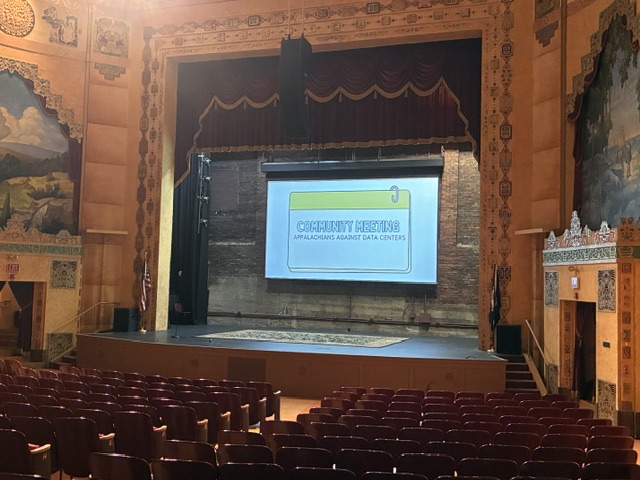
 A new grassroots organization has formed in Smyth County amid rising public concern over the environmental, economic, and quality‑of‑life impacts of large‑scale data centers. Appalachians Against Data Centers (AADC), created just one week ago, is already drawing attention for its rapid mobilization and its message: rural communities must educate themselves and speak up before industrial‑scale data facilities reshape the region.
The group was founded by Hannah Combs, a lifelong Marion resident, and Fairfax Arnold of Sugar Grove. Both are volunteers who say they were moved to act after witnessing the outpouring of public testimony at the recent Board of Supervisors public hearing at Marion Senior High School last month. Combs said they saw people speaking up, many for the first time, and wanted to give them a place to come together, amplify their thoughts from that meeting, and be heard. AADC is not affiliated with any town or county government.
During early discussions, one resident asked whether locals realized they were already subsidizing data centers elsewhere in Virginia through their electric bills. Combs said this comment would strike a nerve and lead to broader conversation about rising electric rates statewide. She explained that the enormous energy demands of data centers—particularly the new generation of AI‑driven hyper data centers—are contributing to higher costs for ratepayers. Combs emphasized that data centers are not inherently harmful; they were created in the 1990s to provide access to digital services. But the rise of artificial intelligence has changed the scale dramatically. Hyper data centers are being built specifically to meet the demand of AI companies and those who profit from AI, and their resource consumption is far beyond what traditional cloud‑storage facilities require.
Research by Walker and Goldsmith (2026) shows that a single AI‑focused data center can consume as much electricity as 100,000 homes, and some facilities are being designed to use up to twenty times that amount. Combs said this level of consumption harms communities, ratepayers, water systems, and rural counties already facing drought risk. She noted that data centers are now being considered for locations across Southwest Virginia, regardless of whether those areas have fragile water supplies.
AADC’s founders say their mission is to educate residents about the real‑world impacts seen in other communities. Water consumption is a major concern, with millions of gallons used daily for cooling and much of it lost to evaporation. Noise is another issue; residents in Loudoun County have reported persistent hums, headaches, and vibrations lasting hours or days. Light pollution has also been documented. One visitor to the AADC meeting described a data center built near farmland in Georgia, where 24‑hour lights, constant noise, and water shortages have become part of daily life. Attendees noted that stories like this are common across the country. Land values have also declined in multiple communities near data center sites.
Members pointed out that Mecklenburg County’s data centers are cloud‑storage facilities rather than AI hyper centers, which is an important distinction when comparing impacts to Loudoun County. The scale and intensity of AI‑driven centers are significantly greater. The Smyth County Board of Supervisors recently made visits to both data centers and reported back that Mecklenburg’s data center was completely quiet and had no observable negative effects.
Watchdog Group of Marion VA founder, Charles Hayden, provided extensive printed research at the group’s recent gathering, including planning commission notes and county ordinance information. Some of these items will be incorporated into the email list AADC is developing.
Hayden said he spoke about data centers at a joint Planning Commission meeting, but county officials walked out while he was speaking. Attendees described a growing trend of officials limiting or disallowing commentary about data centers as was the case at another recent Planning Commission meeting.
The group’s early meetings have focused on practical steps residents can take. Combs encouraged people to attend public hearings, contact local representatives directly, reference nuisance and zoning ordinances, advocate for limits on fossil‑fuel use by data centers, demand mandatory emissions reporting, and continue speaking out. Attendees also encouraged radio and video documentation of meetings. One participant said that if people understood their electric bills could double, it would be a major issue. They suggested that if the county required data centers to generate their own power, companies would likely choose to build elsewhere. Combs agreed, saying these are the kinds of measures residents should advocate for during public meetings. Even if a data center cannot be stopped entirely, she said, its impact can be reduced.
AADC has announced two upcoming opportunities for public involvement: a virtual Zoom meeting on August 24 and an in‑person meeting on September 14, with the location to be announced. The group says these sessions will focus on education, ordinance review, and helping residents learn how to use their voices effectively. Arnold said their goal is to help people understand the harm data centers can do. The Board of Supervisors is likely to rely heavily on economic arguments, he said, and AADC wants residents to be equipped with facts rather than fear—and to know how to make themselves heard.
Three County News will continue to follow the development of Appalachians Against Data Centers and the broader debate over data center expansion in Southwest Virginia. Connect with Appalachians Against Data Centers on Facebook here

