
THE PARKS CASE: An Investigative Examination of Abatement, Arrest, and Due Process in Marion, Virginia
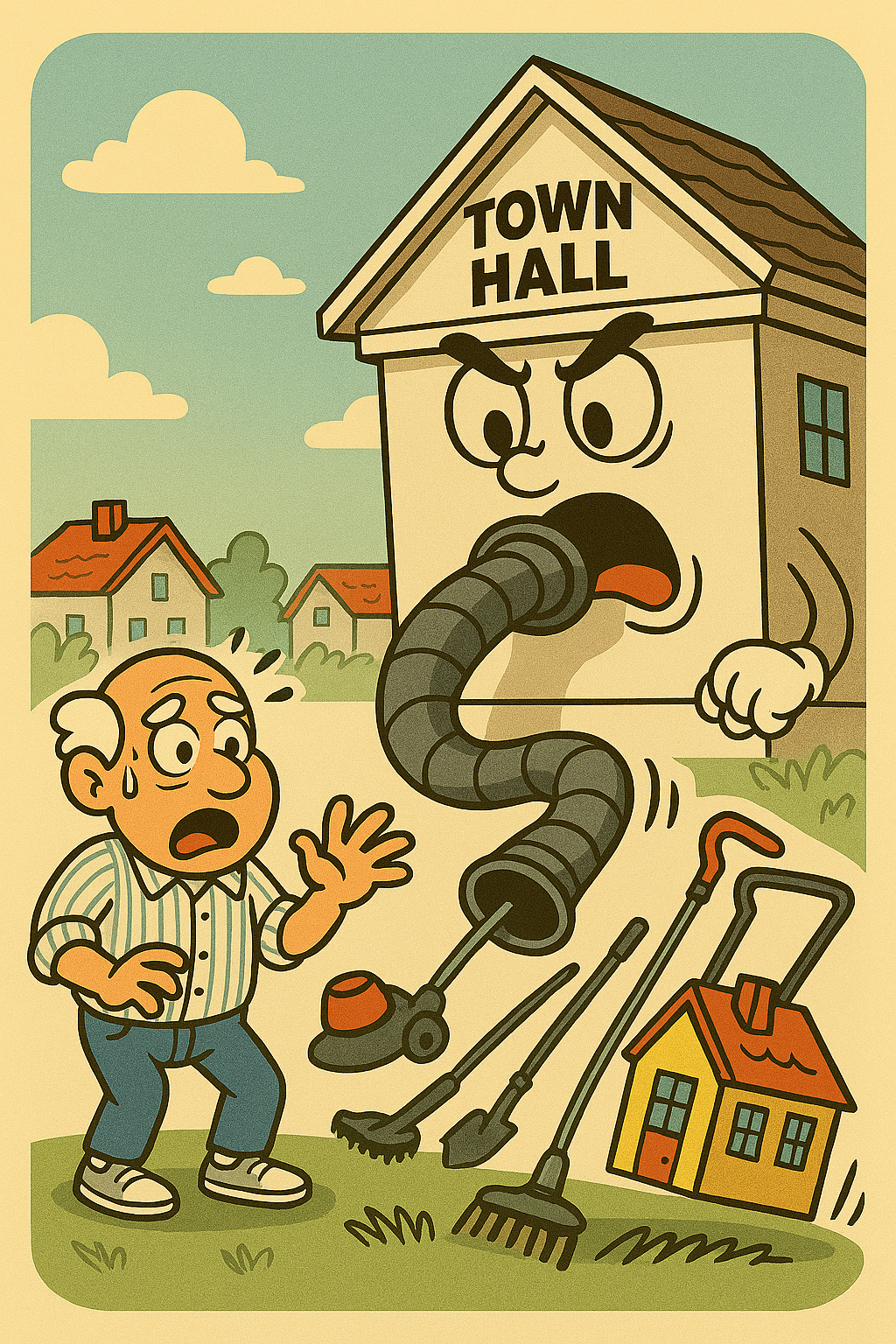
The Town of Marion’s handling of the August 2025 abatement at the home of Danny and Rebecca Parks, followed by the arrest of Danny Parks, has become one of the most closely examined municipal actions in recent years. What began as a property maintenance action has evolved into a case involving missing documents, conflicting video evidence, questions about lawful entry, concerns about selective enforcement, and allegations of attempts to influence the outcome of an ongoing criminal matter. Over several months, Three County News has reviewed body worn camera footage, drone videos, FOIA productions, council minutes, court filings, and comparable abatement cases. The findings raise significant questions about due process, the handling of evidence, and the treatment of a vulnerable family living on fixed incomes and with documented disabilities.
The Parks property had already been the subject of public attention before the 2025 abatement. On July 24, 2023, Smyth County News published an article detailing abatement actions for four properties: the Parks residence, a property on Pearl Avenue, one on Chilhowie Street, and another on South Church Street. Three County News made an extensive request for information on these abatements. The form letters mailed to these property owners contained a clear instruction that if they had anything of value they wished to keep, it must be out of sight from street or right of way view before the day of the abatement. This instruction established the town’s own written standard for how residents should protect their belongings and demonstrated that the town recognized its obligation to avoid removing or damaging items that were properly placed out of view.
Despite this precedent, the Parks abatement in August 2025 did not follow the same pattern. In every other abatement case reviewed by Three County News, the town’s file included a criminal complaint form, a document used to establish the legal basis for entering private property, identify the alleged violation, and cite the statutory authority for abatement. This form was missing from the Parks case. The absence is significant because the Parks property was clearly posted with No Trespassing signs, raising the legal threshold for entry. Without the complaint form, it remains unclear what authority the town relied upon to enter the property on August 6, and town officials have not provided an explanation for its absence.
The events of the abatement day further complicate the picture. Three County News documented and witnessed town employees physically removing a section of the Parks family’s privacy fence at the rear of their property, which provided access to the backyard. This area was also clearly posted No Trespassing, a fact visible in the body worn camera footage later obtained through FOIA and also clearly visible from the street at the front of the residence. The removal of the fence granted town personnel access to the very area where items of value were supposed to be protected under the town’s own written instructions. It also raises questions about whether the town had lawful authority to enter the property at all, especially in light of the missing complaint form.
After the abatement, an email exchange between the Parks family and the Town of Marion, coupled with statements published in the newspaper quoting Todd Long of the Town of Marion Ordinance and Zoning office, revealed that the town later claimed they had damaged the fence, had placed it into storage, and had purchased replacement parts. These replacement materials were never returned to Mr. Parks. The sequence of events suggests the possibility that the town may have been attempting to retroactively justify or cover for the mistaken or unlawful removal of the Parks family’s privacy fence. The lack of documentation, the missing complaint form, and the town’s shifting explanations all contribute to growing concerns about the legitimacy of the abatement process.
A comparison of the Parks abatement with other abatements further highlights inconsistencies. In the three other abatements reviewed, photos were taken from the street at the front of the property, with no side street or alternative vantage points. In the Parks case, photos were taken from multiple angles, including side streets and other vantage points, other streets and through back yards suggesting a level of scrutiny not applied to other residents. The volume of documentation was also disproportionate. The Parks abatement produced as many photographs as the other three abatements combined, raising questions about whether the Parks family was being singled out.
Questions have also emerged about the dumpster service used during the Parks abatement, which was not contracted through an outside vendor but instead leased from a town employee who was already on the municipal payroll. Additional scrutiny has focused on the scrap metal taken to Berry’s, where payout records show that a town employee—not the Town of Marion—received the money, even though the material came from a town ordered abatement. Berry’s CEO, Bill Rush, is himself a recent former Marion Town Manager, adding another layer of concern about oversight and process. When documentation was requested, town offices were reluctant to provide legible copies of the scrap tickets identifying who was paid at drop off, and they did not produce any check made payable to the Town of Marion. Instead, officials supplied only a handwritten receipt claiming a cash payment had been received, leaving unresolved questions about transparency and the proper handling of public resources. Three County News visited Berry’s requesting information about the payouts. We were shown clear high-resolution photos of the vehicle that brought the scrap in as well as on screen documentation of tag numbers, a clear driver’s license image and other identifying information confirming the individual who was paid was a town employee. We were not permitted to take the print outs of that information per Bill Rush when the cooperative worker inquired about this.
In January 2026, a Notice of Claim was delivered to Town Attorney Mark Fenyk during a council meeting. The Notice of Claim pertained directly to the abatement and placed the town on formal notice of potential legal action. This step is significant because it establishes a documented timeline of when the town became aware of alleged procedural violations and property damage. Notices of Claim also serve to protect against lapsing statutes of limitations on certain things.
The handling of video evidence adds another layer of concern. At an August 2025 town council meeting, a member of the Watchdog Group of Marion formally requested all body worn camera footage related to the abatement which had previously been inaccessible to the Parks Family due to cost associated. A check was presented to cover the extreme cost of the FOIA production in the amount of $508.66. The following day, the same individual retrieved the FOIA materials on behalf of the Parks family. The production consisted of a one terabyte external hard drive containing multiple videos from several different body worn cameras, a variety of drone videos recorded during the abatement, and specifically the body worn camera footage from town employee Flave Davis. This footage was later found to be entered into discovery as the primary evidence for the alleged assault charge against Parks.
None of the videos contained timestamps. The absence of timestamps raises concerns about the ability to verify the chronological sequence of events and whether metadata was removed during export. Several videos also show town employees engaging in conduct that raises questions about the legitimacy and intent of the abatement. Employees were recorded creating stash piles of items taken from the Parks property, discussing items they could use for their own personal benefit, and in at least one instance, removing items from the property and placing them into a town vehicle rather than disposing of them in the dumpster as required.
The discovery video, recorded by Davis, is the basis for the assault charge against Parks, yet it does not show either Parks’s or Davis’s hands other than Parks covering the camera, leaving critical moments obscured. No physical struggle is apparent or audible, no change in tone of voice or rate of speech is heard. A segment also appeared to be missing when The Watchdog Group was able to view the discovery with then appointed attorney Jimmie Hess. Specifically, the portion where Davis calls out to Marion Police Department Officer Jeff Horn and states, “Let’s get assault charges on him and get him out of here,” was not shown in the discovery version. This omitted segment is significant because it suggests intent to initiate charges rather than a spontaneous reaction to an assault. It also shows that Officer Horn did not witness the incident, as he was positioned on the street on the opposite side of a dumpster with said dumpster obstructing his view completely. Additionally, with machinery that was running and other noise, he would not have heard anything either from this position.
Another video, recorded by a different crew member and not entered into discovery, captures the incident from farther away. This footage shows no assault. Instead, it shows Parks covering Davis’s camera, taking Davis by the sleeve, and instructing him to leave the property. This video contradicts the narrative implied by the Davis footage and raises questions about selective disclosure and whether exculpatory evidence may be withheld. Parks has been represented by a court appointed attorney. None seem to be interested in looking at other evidence that may provide additional context as to what really happened. Parks has also been unable to get this evidence submitted for consideration.
The legal process that followed the arrest has been marked by delays and procedural detours. On December 2, 2025, court appointed attorney Jimmie Hess requested a mental evaluation for Parks. On December 10, Hess returned to court and made a motion for Restoration Services based upon the evaluation, which was granted. Hess then withdrew from the case on January 13, 2026. Records reflect that Hess submitted a request for a Motion to Withdraw in December immediately following that court appearance to be heard on January 13th. Parks submitted a request for a new appointed attorney citing failure to communicate and lack of representation.
This prolonged further the legal process. Michaela Gemmell was then appointed to the case. Parks was recently declared competent to stand trial after completing approximately 6 Restoration Services classes. The timing and sequence of these motions have raised questions about whether the evaluation and Restoration Services were necessary or whether they served as a mechanism to stall the legal process. Statute of Limitations would have expired in early February because some of the items in the larger case against the town had no Notice of Claim been provided prior to the 6 month mark.
Concerns about the handling of the criminal case intensified during Parks’s first hearing following his arrest, when an incident occurred that appeared to be aimed at creating grounds to revoke his bail. One of the conditions of Parks’s bail prohibited the use of any non prescribed drugs. During his first hearing, an allegation was made in the courtroom that Parks smelled like marijuana. Parks recognized Probation Officer Thomas Weaver in the courthouse that day and approached him after the allegation was made requesting a voluntary drug test. Weaver later confirmed in an interview with Three County News that someone in the courtroom had suggested Parks smelled like marijuana, prompting the discussion and drug test.
Parks voluntarily requested a drug test to clear his name. Weaver administered the test. According to Weaver, the test screened for multiple substances, including marijuana. Parks passed the test, and the results showed he was clean of all substances, including marijuana. Weaver confirmed that the test was voluntary and that Parks had not been ordered to take it by the court and had come to him requesting it. The timing of the allegation contributed to ongoing concerns in this case.
Shortly after this incident, the Watchdog Group of Marion, Virginia formally organized as a nonprofit organization. One of its first actions was to raise funds to provide court reporters for Parks’s subsequent court appearances. The decision to secure court reporters was made to ensure that all proceedings were documented in a manner that is admissible at a later date. Court reporter presence is known to promote better behavior and adherence to procedure in courtrooms because all parties are aware that their statements and conduct are being recorded verbatim. The Watchdog Group has confirmed that this documentation will be preserved for use at a later date.
Taken together, the evidence reviewed by Three County News suggests a pattern of irregularities. The Parks abatement was documented more extensively than others. Standard documents were missing. Standard procedures were not followed. Video evidence was incomplete, missing time stamps, and selectively entered. The arrest was based on a verbal request from Flave Davis heard in video footage, while exculpatory footage was potentially not included in discovery. Town employees were recorded removing property for personal use. A Notice of Claim was delivered to the town before the criminal case advanced. Town Attorney, Mark Fenyk publicly downplayed this at a January meeting of the Marion Town Council. The legal process has been prolonged through repeated continuances and procedural detours. And an allegation made in court, later contradicted by a drug test, raises questions about whether there were attempts to influence the outcome of the criminal case by targeting Parks’s bail conditions. In December 2025, the Town of Marion’s attorney, Mark Fenyk, publicly clarified that Flave Davis was a hired employee rather than an appointed official, a distinction that carries significant legal implications. Fenyk has also been observed at each court appearance but is not a participant in the assault charge against Parks. The April 15, 2024 council minutes had recorded Davis as having been appointed by council vote, a designation that would have made him an officer of the town whose actions legally bind the municipality. The December clarification reclassified Davis as a standard employee, not an appointed official, and therefore not acting with the same level of delegated municipal authority. This shift occurred after the August 2025 abatement and after substantial concerns had been raised about the legality of the town’s actions on the Parks property and some of the videos published on the Rumble channel associated with the Watchdog Group of Marion Virginia. The timing of the reclassification has prompted questions about whether the town sought to limit its liability by altering Davis’s status after the fact, particularly given that his body worn camera footage became the central piece of evidence in the assault charge against Parks.
The Parks case is more than a dispute over property maintenance. It is a window into how municipal authority is exercised, how evidence is handled, and how vulnerable residents can be swept into a legal process that feels opaque, inconsistent, and unbalanced. As the case moves toward its next hearing scheduled for April 9th at 1:30 in Smyth County General District Court, the unanswered questions remain. Why was the criminal complaint form missing? Why were standard abatement procedures not followed? Why was exculpatory video potentially not included in discovery? Why were timestamps absent from all FOIA produced videos? Why were town employees recorded removing property for personal use under direct supervision of Todd Long and Flave Davis? Why did the Parks abatement receive disproportionate scrutiny? The case was able to be moved forward from May.
As the case continues, the length and structure of the legal process itself have become part of the concern. The sequence of continuances, the initiation of a mental evaluation, the referral to Restoration Services, the withdrawal of counsel, and the repeated procedural resets have collectively extended the case far beyond what is typical for a misdemeanor assault charge arising from a property abatement. While each action is, on its face, a recognized component of the judicial system, the cumulative effect has been a prolonged and fragmented process that has delayed resolution. When viewed alongside the missing documentation, the inconsistencies in video evidence, the disputed conduct during the abatement, and the early potential attempt to challenge Parks’s bail through an allegation later disproven by a drug test, the drawn out nature of the proceedings raises legitimate questions about whether the delays are merely incidental or whether they reflect a deliberate effort to exhaust, pressure, or disadvantage a defendant with limited resources. The totality of these circumstances underscores the need for transparency, accountability, and a timely adjudication of the matter so that the facts can be evaluated on their merits rather than lost in procedural drift.
Three County News will continue to follow this case closely.

